
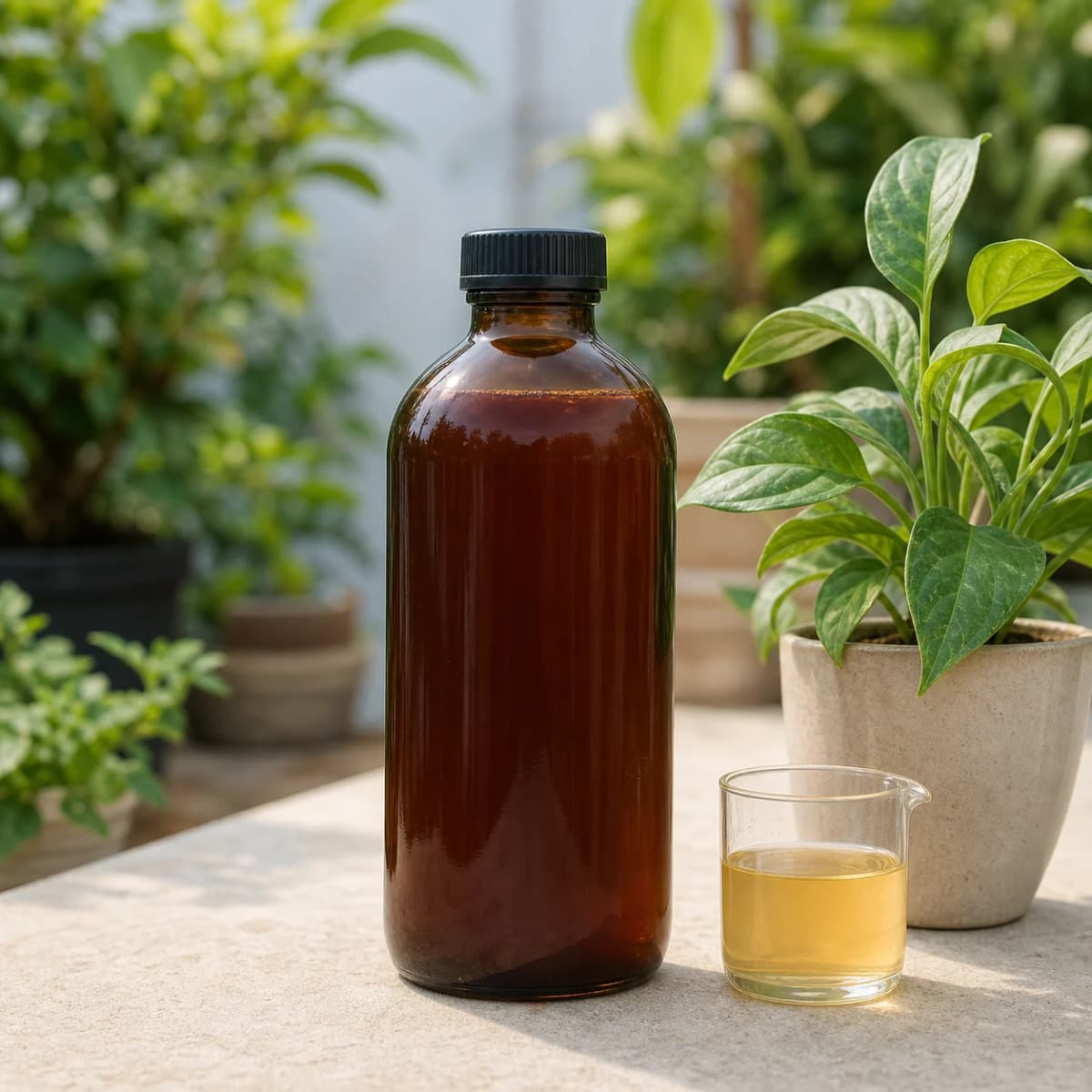
Vermiwash is a liquid taken from worm-worked compost. This guide explains what that liquid is, how a vermicompost unit yields it, and how Growee Farms tells gardeners to dilute and time Growee Premium Vermiwash. Packs and price stay on that product page. This page does not repeat them.
What vermiwash is
Growee's product page calls Premium Vermiwash a liquid plant tonic and a vermicompost extract. It is for a soil drench or a foliar spray, not for digging into a bed the way solid compost is. The same page names vegetables, herbs, flowering plants, fruit plants and ordinary garden upkeep as the usual plant groups, and it names balcony gardens, terrace pots, grow bags and kitchen gardens as the usual places.
The Tamil Nadu Agricultural University Agritech Portal describes the same kind of liquid in its plant-care note. One method starts with compost from a worm bed. Another line on that page treats vermiwash as a spray for plant growth. Read that note here: TNAU Agritech Portal, Plant Care / Crop Nourishment. Growee's bottle is a finished product with its own directions. A wash you collect at home is a different liquid until you know how it was made.
How vermiwash is collected from a vermicompost unit
TNAU's vermi-wash procedure is a home method, not a description of how Growee bottles its tonic. The steps on that page are specific:
Take 10 kg of compost from a vermicompost bed that already holds a high density of earthworms. Put that compost in a jute bag. The note says not to use a plastic bag. Fill a tub with 10 litres of water. Dip the jute bag slowly into the water five times. The water left in the tub is the liquid they say is ready to use as a spray.
That is collection from a vermicompost unit: water passes through worm-worked compost, and the water in the tub is the wash. The note gives no microbe count, hormone figure or yield percentage, so this guide adds none.
A later line on the same page is about spraying. It says to dilute one litre of vermiwash in 20 litres of water for a foliar spray, with three to four applications. It also mentions half a litre of vermiwash plus half a litre of cow urine in those 20 litres. Growee's product page does not tell you to add cow urine. If you are using the Growee bottle, skip that mix.
The same page has another spray line: one litre of cow urine, pot manure, vermiwash, bio sol or compost tea in 14 litres of water. That ratio is not Growee's label. When the notes disagree, follow the bottle you hold.
How to use vermiwash
Gardeners who look up how to use vermiwash need the dilution, the choice between a soil drench and a foliar spray, and the time of day. Growee's labelled direction for how to use vermiwash is 50 ml in 1 litre of water, applied in the early morning or evening.
Dilution
The product page's dilution tile says to mix 50 ml in 1 litre of water before application. Its pack summary also shows 50 ml per litre as the recommended dilution. Mix 50 ml of Growee Premium Vermiwash in 1 litre of water, then use that mix as a soil drench or a foliar spray.
Fifty millilitres in one litre is one part in twenty, the same ratio as TNAU's one litre in twenty litres. It is not the one-in-fourteen line. Do not average them. If you mix less than a litre, keep the ratio: half a litre of water takes 25 ml. The page also says to start conservatively on delicate plants and to watch the plant before you apply more often.
Soil drench or foliar spray
The product page lists both uses. A soil drench means you pour the diluted mix on the root zone. The page says to use the tonic around the root zone, or as part of the usual feeding routine, for balcony and indoor-adjacent pots. A foliar spray means you wet the leaves with the same dilution. TNAU's growth-promoter line is a foliar spray. Growee does not say that one method replaces the other.
Do not apply the mix to soil that is already waterlogged. The product page says to avoid overuse on waterlogged soil. It does not make a pest-control claim for the drench or the spray, and this guide does not add one.
Timing and how often
Apply the diluted mix in the early morning or evening, and repeat the application weekly during active growth. The product page's weekly-routine tile says to apply in the early morning or evening as directed. Another line says to apply during the cooler parts of the day. Midday heat is the part of the day those lines are steering you away from.
Weekly is Growee's suggested routine, including during kitchen-garden crop cycles and flowering stages. TNAU's foliar note instead says three to four applications of its one-in-twenty spray. Those are not the same calendar. On a Growee bottle, follow the weekly product-page routine. Do not turn TNAU's three-to-four field sprays into a Growee schedule, and do not turn Growee's weekly home routine into a farm acre rate.
If a plant is delicate, keep the 50 ml per litre mix and wait to see how it responds before you shorten the gap. The product page says to observe the plant before increasing frequency. It does not tell you to strengthen the mix.
Vegetables, flowers and potted plants
The product page names the plant groups in more than one place. The benefit tiles say vegetables, flowers and potted plants. The longer product text also names herbs, flowering plants, fruit plants, balcony gardens, terrace pots, grow bags and kitchen gardens.
Vegetables and kitchen gardens
Use the diluted tonic as a liquid feed beside compost, mulch and watering. The product page says a kitchen garden should get that steady support through the season. It does not promise a larger harvest. Read how to start a terrace garden in India if the bags and beds are not in place yet.
Flowers
Flowering plants are named both for ordinary upkeep and for the flowering stage. Growee's weekly morning or evening application is the routine during that stage. The dilution stays 50 ml per litre. The page does not rank one flower above another.
Potted and terrace plants
Potted plants and terrace pots are the home case for how to use vermiwash between heavier compost applications. Balcony pots, grow bags and terrace gardens are where the product page says a liquid feed is easier than another heavy top dressing. Pour the drench on the root zone, or spray the leaves, and skip a pot that cannot drain. Herbs and fruit plants are on the same use list and take the same dilution. The page does not publish a separate herb rate or fruit-tree rate.
Vermiwash, vermicompost and Bio Fusion
These three Growee products are not substitutes with different labels. The form decides the job.
| Question | Growee Premium Vermiwash | Premium Vermicompost | Bio Fusion | |---|---|---|---| | Form | Liquid vermicompost extract | Solid soil conditioner | Granular fertilizer | | Job on the product page | Soil drench or foliar feed for vegetables, flowers and pots | Soil structure, moisture and slow nutrition for pots, beds and farm soil | Granular feed around the root zone | | Growee direction | 50 ml in 1 litre of water, weekly, early morning or evening | Follow the vermicompost product page for its own rates | Follow that page; it currently marks the product out of stock | | Where to check packs | Premium Vermiwash | Premium Vermicompost | Bio Fusion |
Premium Vermicompost is the solid input. Growee's vermicompost page calls it an organic soil conditioner for pots, terrace gardens, kitchen gardens, vegetables, flowers, herbs and farm soil, made as earthworms and microbes break down plant and farm waste. Use it when the soil itself needs organic matter. The wash does not rebuild a tired potting mix on its own.
Bio Fusion is Growee's granular organic fertilizer. Its page describes a granular soil feed and currently marks the product out of stock. Use the link to compare the product type. Do not read it as a promise that you can order Bio Fusion today.
Many gardeners keep compost in the pot and use a liquid only as the repeat feed. That pairing is what Growee's vermiwash page suggests when it says to use the tonic alongside compost. Browse the wider organic fertilizer range if you are still choosing a form. If the plant or the pot is unusual, contact Growee before you mix a larger batch.
What to check before you rely on a vermiwash label
Check four things on the pack and on the product page. The product should say it is a liquid from vermicompost, not a solid manure with a liquid-sounding name. The label should state a dilution. Growee's rate is 50 ml in 1 litre of water. It should say soil drench, foliar spray, or both, and it should say when and how often. Growee says both methods, weekly, in the early morning or evening.
The product page lists 1 L and 5 L as the pack sizes in its pack summary. Check the current packs and price on the Premium Vermiwash product page before you order. This guide does not copy a price or a stock status. A yield percentage, a hormone number or a pest cure is not on Growee's vermiwash directions, so it is not repeated here.
Delivery and payment
The shipping policy states that orders of ₹999 and above receive free standard shipping across India. Standard delivery on that page is counted in business days, from a few days in metro cities to longer in rural and remote areas. Check the delivery details for your address at checkout. That is not a same-day promise.
All Growee orders are prepaid. Pay by UPI, card or net banking. Growee does not offer cash on delivery.
Questions gardeners ask
What is vermiwash?
It is liquid collected from worm-worked compost. TNAU describes dipping compost from a worm bed in water and using that water as a spray. Growee Premium Vermiwash is the bottled vermicompost extract on Growee's product page, for a soil drench or a foliar spray.
How much Growee vermiwash goes in one litre of water?
The product page says 50 ml in 1 litre of water. Keep that ratio if you mix less. The page does not give a different rate for vegetables, flowers or pots.
Do I pour it on the soil or spray the leaves?
Both are on the product page. Pour the diluted mix on the root zone for a drench, or wet the leaves for a foliar spray. Skip soil that is already waterlogged.
How often should the application be repeated?
Growee's page says weekly, in the early morning or evening, during active growth, flowering and a kitchen-garden crop cycle. A short checklist for how to use vermiwash is to mix the labelled dilution, apply it in the early morning or evening, and repeat weekly during active growth.
Can vermiwash replace vermicompost or Bio Fusion?
No. Vermicompost is the solid soil conditioner. Vermiwash is the liquid feed. Bio Fusion is the granular fertilizer, and its page currently marks it out of stock. They answer different jobs. Follow each product's own directions.
Where are the current packs and the price?
On the Premium Vermiwash product page. The page shows 1 L and 5 L in its pack summary. Confirm the packs and the price there at the time you order.