
If you are searching for the best organic fertilizer for home garden in India, you are already making a smart choice. Whether you grow tulsi on your balcony, tomatoes on your terrace, or roses in your backyard, feeding your plants with the right organic fertilizer can mean the difference between a struggling garden and a thriving one.
In this comprehensive guide, we break down the top 5 organic fertilizers available in India, explain how to apply them correctly, and help you pick the one that suits your garden best. If you are just getting started, you may also want to read our guide on how to start a terrace garden in India.
What is organic fertilizer?
Organic fertilizer is a plant feed made from plant, animal or mineral matter, or living microbes. Many solid inputs work mainly by building soil organic matter and releasing nutrients gradually as they break down. The types differ: compost adds material to the soil, while liquid extracts and microbial inputs play supporting roles rather than replacing a complete soil-feeding plan.
- Composted materials: Vermicompost and finished compost provide a base for pots and beds while improving soil structure.
- Plant-based meals: Neem cake is an example used here for leafy vegetables and soil feeding.
- Animal-based meals: Bone meal supplies phosphorus and is discussed below for flowering plants, bulbs and roots.
- Plant extracts: Seaweed extract is a liquid supplement for foliar feeding or a soil drench.
- Bio-fertilizers: Rhizobium, Azospirillum and PSB are living microbial inputs used to support nutrient availability in organic-matter-rich soil.
These categories describe different jobs, not a ranking from weakest to strongest. When choosing organic fertilizer for plants, first decide whether you need a soil-building base, a targeted nutrient supplement or a liquid feed. A potting mix with little organic matter needs a different approach from a bed that already receives finished compost. The Top 5 section below explains the uses and application methods of each garden input.
Why Organic Fertilizers Are Better for Your Home Garden
Chemical fertilizers have dominated Indian agriculture for decades, but home gardeners across the country are increasingly turning to organic alternatives. The reasons are practical, not just ideological. Understanding the difference between organic and synthetic feeding is the first step toward building a garden that stays productive year after year.
Home-garden fertilizer choices are not a field plan, and organic farming in Punjab is the separate guide for that regional question.
Organic fertilizers improve soil health over time. Unlike chemical fertilizers that deliver a quick burst of nutrients and then leave the soil depleted, organic options like vermicompost and neem cake add humus and organic matter to the soil. This improves soil structure, increases water retention in sandy soils, and enhances drainage in clay-heavy soils — both common conditions across India. Over successive growing seasons, organically fed soil becomes richer, darker, and more alive with beneficial organisms.
They support microbial activity that plants depend on. Healthy soil is not just dirt — it is a living ecosystem. Billions of bacteria, fungi, and other microorganisms break down organic matter, fix nitrogen from the atmosphere, and make phosphorus and potassium available to plant roots. Chemical fertilizers, especially when overused, can disrupt this microbial balance by raising soil salinity and altering pH levels. Organic fertilizers, on the other hand, serve as food for these microorganisms, creating a self-sustaining cycle of nutrient availability. This is particularly important in Indian home gardens where the same pots and beds are used season after season.
They are safe for edible plants and families. If you grow vegetables like tomato, chilli, brinjal, or herbs like tulsi, coriander, and curry leaves, the safety of your fertilizer matters. Chemical fertilizers can leave nitrate residues in the soil and on produce, which is a concern for home growers who harvest and eat from the same garden. Organic fertilizers break down naturally and do not introduce harmful synthetic compounds into your food chain. You can harvest your greens, rinse them, and eat them with confidence.
Organic fertilizers are more forgiving for beginners. One of the biggest risks with chemical fertilizers is over-application. Adding too much urea or DAP can burn roots, kill seedlings, and permanently damage potted plants. Organic fertilizers release nutrients slowly, making it nearly impossible to overfeed your plants. For new gardeners who are still learning the right dosages, this margin of safety is invaluable.
Top 5 Organic Fertilizers for Indian Home Gardens
Choosing the best organic fertilizer for your home garden in India depends on what you grow, your budget, and how much time you want to spend on soil care. Here are the five best options, each with distinct strengths.
1. Vermicompost
Vermicompost is decomposed organic matter processed by earthworms, and it is widely considered the gold standard of organic fertilizers in India. The worms consume kitchen waste, cow dung, and plant debris, and their castings produce a nutrient-rich, odourless material that plants love.
NPK ratio: Approximately 1.5-2 : 1 : 0.8 (Nitrogen : Phosphorus : Potassium). While the numbers may look modest compared to chemical fertilizers, vermicompost also supplies calcium, magnesium, zinc, and a host of beneficial microbes that chemical options simply cannot replicate.
Best for: Vermicompost is an all-rounder. It works exceptionally well for vegetables (tomato, chilli, brinjal, spinach), herbs (tulsi, coriander, mint), and flowering plants (marigold, hibiscus). It is particularly effective for potted plants because it improves both drainage and moisture retention simultaneously.
How to use: For potted plants, mix vermicompost into the top 2-3 inches of soil at a ratio of roughly 20-30% of total soil volume. For garden beds, spread a 1-inch layer on the surface and work it in lightly. Apply every 30-45 days during the growing season. You can also make vermicompost tea by soaking a handful in a litre of water overnight and using the liquid as a foliar spray or root drench. Growee Premium Vermiwash is a vermicompost extract used as a soil drench or foliar spray at 50 ml per litre of water.
Where to find it: Vermicompost is widely available at local nurseries, agricultural shops, and online platforms across India. You can also produce it at home with a simple vermicomposting bin. Growee Farms sells its own bagged option as Growee Premium Vermicompost for pots, beds and terrace gardens.
2. Neem Cake
Neem cake is the residue left after neem seeds are cold-pressed to extract neem oil. It has been used in Indian agriculture for centuries, and it serves a dual purpose that no other organic fertilizer can match: it feeds the soil and protects plants from pests.
NPK ratio: Approximately 4-5 : 1 : 2. The relatively high nitrogen content makes neem cake an excellent choice for leafy vegetables and plants that need vigorous vegetative growth.
Best for: Neem cake is ideal for vegetables, especially leafy greens like spinach, methi, and lettuce. It also benefits fruit-bearing plants like tomato and chilli by keeping soil-borne pests such as nematodes, white grubs, and termites at bay. Rose growers often use neem cake to suppress aphid populations in the soil.
Pest control benefits: The active compounds in neem cake — azadirachtin and other limonoids — act as natural insecticides and fungicides. When mixed into the soil, they deter root-knot nematodes, fungus gnats, and other pests that attack from below. This dual-action makes neem cake particularly valuable for Indian gardens where warm, humid conditions attract a wide range of pests.
How to use: Mix 50-100 grams of neem cake per pot (for medium-sized containers) into the topsoil. For garden beds, apply 500 grams per square metre. Water the soil well after application. Reapply every 30-45 days. Avoid direct contact with plant stems, as concentrated neem cake can cause mild irritation to tender stems.
3. Bone Meal
Bone meal is made from finely ground animal bones, typically steamed and processed to make nutrients more accessible to plants. It is one of the best natural sources of phosphorus, a nutrient that drives root development and flower production.
NPK ratio: Approximately 3 : 15 : 0. The exceptionally high phosphorus content is what sets bone meal apart from other organic fertilizers. It also contains about 20% calcium, which strengthens cell walls and prevents disorders like blossom end rot in tomatoes.
Best for: Bone meal is the go-to fertilizer for flowering plants — roses, jasmine, mogra, bougainvillea, and hibiscus all respond beautifully to phosphorus-rich feeding. It is also excellent for bulbs (tuberose, lily, gladiolus) and root vegetables (carrot, radish, beetroot) where strong root development is critical.
Slow-release advantage: Unlike water-soluble chemical phosphorus fertilizers that leach out of the soil quickly, bone meal breaks down gradually over 2-4 months. This means a single application keeps feeding your plants steadily through an entire growing season. For Indian gardeners who prefer a low-maintenance approach, this is a significant advantage.
How to use: Work 1-2 tablespoons of bone meal per pot into the soil at the time of planting or repotting. For garden beds, apply 200-300 grams per square metre. Since bone meal is slow-release, you only need to apply it once every 3-4 months. Mix it into the soil rather than leaving it on the surface, as it needs to be in the root zone to be effective.
4. Seaweed Extract
Seaweed extract is derived from marine algae and is rapidly gaining popularity among Indian home gardeners. While it is not a heavy-hitter in terms of NPK, its real value lies in the broad spectrum of micronutrients and natural growth hormones it delivers.
NPK ratio: Approximately 1 : 0.5 : 2-3. The numbers are low, but seaweed extract contains over 60 trace minerals including iron, manganese, zinc, copper, and boron. It also contains natural cytokinins, auxins, and gibberellins — plant hormones that stimulate cell division, root growth, and flowering.
Best for: Seaweed extract benefits virtually every plant in your garden, but it is especially effective for plants under stress — transplanted seedlings, heat-stressed summer crops, and plants recovering from pest damage. It is also excellent for flowering and fruiting plants where the hormonal boost can increase bud count and fruit set.
Foliar spray advantage: Unlike most organic fertilizers that work through the soil, seaweed extract is highly effective as a foliar spray. When sprayed on leaves, the micronutrients and growth hormones are absorbed directly through the leaf surface, delivering results faster than soil application. This makes it an excellent complement to your primary fertilizer.
How to use: Dilute liquid seaweed extract according to the product label — typically 2-5 ml per litre of water. Use it as a foliar spray every 15-20 days, preferably in the early morning or late evening when stomata are open. You can also add it to your watering can for root application. Seaweed extract works best as a supplement alongside a primary fertilizer like vermicompost or Bio Fusion.
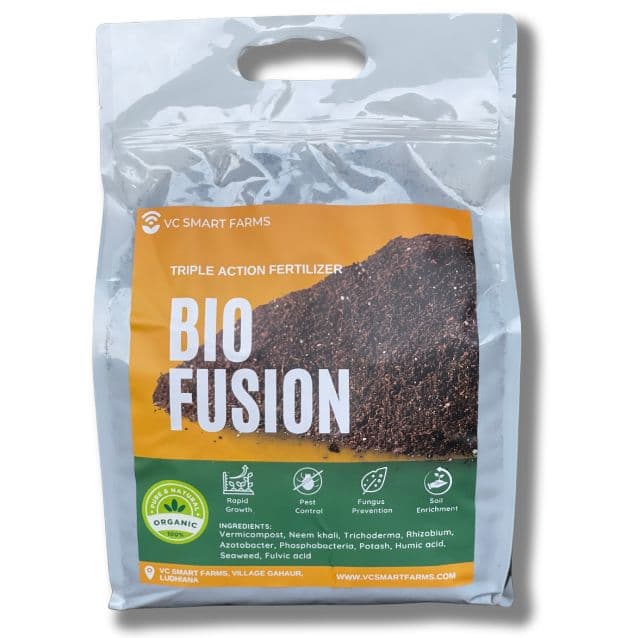
5. Bio Fusion by Growee Farms
If you want a single product that covers all your bases, Bio Fusion by Growee Farms is the answer. Designed specifically for Indian home gardens, Bio Fusion is a triple-action organic fertilizer that combines the best of multiple organic inputs into one convenient formula.
What makes Bio Fusion different: Bio Fusion is not a single-ingredient fertilizer — it is a scientifically formulated blend that combines vermicompost extract with a balanced spectrum of macro and micronutrients. This triple-action approach means it feeds the plant, enriches the soil microbiome, and supplies trace minerals that most single-source organic fertilizers miss. The result is healthier plants that grow faster, flower more, and resist disease better.
Available in two formats: Bio Fusion comes as both a liquid concentrate and a granular formula. The liquid version is ideal for foliar spraying and quick root drenches, while the granular version is perfect for mixing into potting soil or topdressing garden beds. This flexibility lets you choose the application method that works best for your setup.
Proven results: In controlled trials, plants fed with Bio Fusion showed up to 40% more growth compared to plants fed with single-source organic fertilizers. Home gardeners across India have reported denser foliage, more prolific flowering, and stronger root systems within just 3-4 weeks of first application. Whether you grow chilli, tomato, rose, jasmine, tulsi, or ornamental houseplants, Bio Fusion delivers visible results.
How to use: For granular Bio Fusion, mix 1-2 tablespoons per pot into the top layer of soil and water thoroughly. For garden beds, apply 100-150 grams per square metre. For liquid Bio Fusion, dilute as directed on the label and apply every 15-20 days. You can combine it with seaweed extract for an even more comprehensive feeding programme.
Ready to try Bio Fusion? Browse our complete range of organic fertilizers at our fertilizer shop.
How to Apply Organic Fertilizer: A Quick Guide
Knowing which fertilizer to use is only half the equation. Applying it correctly ensures your plants actually absorb the nutrients you are providing. Here are the key principles every Indian home gardener should follow.
Dosage: Potted Plants vs Garden Beds
Potted plants live in a confined volume of soil, so they need smaller, more frequent doses. A general rule: use 1-2 tablespoons of granular organic fertilizer per medium pot (8-12 inches) and 2-3 tablespoons for large pots (14 inches and above). For garden beds, apply 100-200 grams per square metre, depending on the product and the plants you are growing.
Always err on the side of less rather than more. While organic fertilizers are far more forgiving than chemicals, excess application can still create nutrient imbalances over time, particularly with high-phosphorus products like bone meal.
Frequency
Most organic fertilizers perform best when applied every 15-20 days during the active growing season (typically February through November in most parts of India). During peak summer (May-June) and the monsoon season, your plants are growing fastest and consuming the most nutrients, so consistent feeding is critical.
Slow-release products like bone meal and well-composted vermicompost can be applied less frequently — once every 30-45 days or even every 3 months, depending on the product.
Best Time of Day
Apply fertilizers in the early morning or late evening, never during the peak heat of the afternoon. This is especially important for liquid fertilizers and foliar sprays. Morning application allows the plant to absorb nutrients during its most active metabolic period, while evening application avoids rapid evaporation.
Water your plants lightly before applying granular fertilizers to moist soil — this prevents root burn and helps nutrients dissolve into the root zone more quickly.
A Composting Tip
If you generate kitchen waste — vegetable peels, tea leaves, eggshells, fruit scraps — consider starting a small compost bin alongside your fertilizer routine. Home compost is an excellent soil amendment that complements any organic fertilizer. Mix finished compost into your potting mix at a 20-30% ratio, and your plants will have the best possible growing medium. Combined with a balanced fertilizer like Bio Fusion, home compost creates a nutrient cycle that keeps your garden productive with minimal external inputs.
How to choose an organic fertilizer for your soil and plants
Start with a soil test from a local agriculture department or lab, especially before feeding a large bed or repeatedly adding one nutrient. Ask the report to guide your choice rather than assuming that the biggest numbers on a packet are best. A soil test can show what is already available; the crop and its growth stage tell you what you are trying to support.
The three NPK numbers on a pack describe the nutrient share by weight, in the order nitrogen, phosphorus and potassium. On conventional labels, phosphorus and potassium are expressed as phosphate and potash equivalents. Nitrogen supports leafy growth; phosphorus supports roots and flowering; potassium contributes to overall plant strength. Read the label's nutrient declaration alongside its directions, because a nutrient ratio does not tell you how much to put in a pot.
Use the applications already described above as a starting point:
- If leafy vegetables need feeding: Consider neem cake, which the Top 5 section recommends for spinach, methi and lettuce. Check the soil report before choosing it simply for its nitrogen content.
- If you are feeding flowering plants, bulbs or root vegetables: Consider bone meal for its phosphorus contribution. More phosphorus is not automatically better when the soil already has enough.
- If recently transplanted or heat-stressed plants need a supplementary feed: Consider diluted seaweed extract, following its label. It complements a base fertilizer rather than replacing soil care.
- If vegetables, herbs and flowers share pots or beds: Start with vermicompost as the all-round soil-building option described above, then add a supplement only for a clear need.
Visible symptoms are a reason to investigate, not a nutrient diagnosis. Before adding another feed, check watering, drainage and the plant's growing conditions as well. Choose one change at a time so you can judge whether it helps. Keep a simple note of the product, application date and label dose; this makes it easier to avoid overlapping feeds and repeated applications that the garden does not need.
Best organic fertilizer for plants: match the feed to the plant
The best organic fertilizer for plants depends on the plant group, existing soil nutrients and recent feeding. Vermicompost is this guide's all-round base for vegetables, herbs and flowers. Use neem cake or bone meal only where the soil test supports that nutrient choice, and treat liquid feeds as supplements rather than automatic extras.
Use this table to shortlist a feed, then check its label against your soil report. The amounts and intervals come from the applications above; they are not instructions to use every product in a row together.
| Plant group | Base feed | Supplement when needed | How often (from this guide's own figures) |
|---|---|---|---|
| Leafy vegetables | Vermicompost for the soil-building base | Neem cake, 50-100 g per medium pot, if the soil test supports additional nitrogen | Vermicompost every 30-45 days during growth; neem cake every 30-45 days only when needed |
| Fruiting vegetables (tomato, chilli, brinjal) | Vermicompost | Seaweed extract as a supplementary foliar feed, 2-5 ml per litre according to its label | Vermicompost every 30-45 days; seaweed every 15-20 days if used |
| Flowering plants and bulbs | Vermicompost | Bone meal only if the soil test indicates a phosphorus need | Vermicompost every 30-45 days; bone meal every 3-4 months if needed |
| Herbs (tulsi, coriander, mint) | Vermicompost | No automatic extra feed; choose any supplement for an identified need | Vermicompost every 30-45 days during the growing season |
| Indoor and potted houseplants | Vermicompost as the soil-building option | A diluted liquid feed if needed; this guide's indoor FAQ uses half strength | Use the indoor FAQ's 20-25-day interval for that liquid option, adjusted to growth and the label |
| Root vegetables | Vermicompost for soil preparation | Bone meal only where a soil test supports adding phosphorus | Vermicompost every 30-45 days during growth; bone meal every 3-4 months if needed |
For the base option, see Growee Premium Vermicompost. This guide describes a 20-30% share of pot soil; that is a soil-mix proportion, not a liquid dilution. For container sizes and pot-by-pot guidance, use the terrace-garden fertilizer and dosage guide.
Growee Premium Vermiwash is another liquid option described here at 50 ml per litre of water. This guide gives its dilution but no separate repeat interval, so do not borrow the seaweed schedule for it. Follow the product's directions and account for the base feed already applied. A flowering plant does not automatically need bone meal, and a leafy crop does not automatically need more nitrogen.
Liquid or granular organic fertilizer: which form suits your plants
Dry organic fertilizers generally release nutrients more gradually, while liquid feeds can act more quickly. Oregon State University Extension describes dry organic products as slower-acting feeds and liquids as useful for a quicker mid-season top-up. That distinction helps you choose an application method; it does not establish a guaranteed response time for a particular product.
For base feeding, use the solid input's directions for incorporating it into soil or topdressing. Growee sells a granular option, Bio Fusion organic fertilizer. For a liquid option, Premium Vermiwash is described in this guide at 50 ml per litre as either a soil drench or a foliar spray. Keep those product directions separate: a granular dose cannot be converted into a liquid dilution.
A soil drench applies the diluted feed to the growing medium; foliar feeding applies it to leaves. Utah State University Extension explains that suitable water-soluble organic products can be used for liquid or foliar applications and warns that incorrect application can burn leaves. Use a foliar application only when the product directions support it, with the stated dilution. A liquid format alone is not permission to spray any fertilizer onto foliage.
To combine forms, count them as one feeding plan. Record the base application before deciding whether a liquid top-up is needed. Compare both nutrient labels with the soil test, including nutrients already supplied by compost or previous fertilizer. Utah State's guidance recommends choosing products with less of a nutrient when the soil test shows it is already high. Do not apply two full feeding routines simply because one product is dry and the other is liquid. Choose the supplement for a specific remaining need, follow its label, and reassess before repeating it.
Organic fertilizer for farming and crops vs home gardens
Choosing organic fertilizer for farming starts with a soil test and a crop plan. Field crops are fed at rates per acre, usually with farm compost, green manure and bio-fertilizers as parts of a wider soil-management routine. Our field guidance on organic farming in Punjab explains those inputs alongside rotation and soil care.
If you grow crops for sale rather than for your own kitchen, our guide to commercial farming in India explains commercial versus subsistence farming and the risks growers consider.
Home gardens and pots need smaller, gentler doses because the available soil volume is limited. Do not copy an acreage rate into a container or multiply a pot dose into a field recommendation. Match the label to the area or soil volume being treated, and use the soil report for larger plantings. Explore compost and manure for larger beds when planning the soil-building part of a garden.
Organic Fertilizer Comparison Table
| Feature | Vermicompost | Neem Cake | Bone Meal | Seaweed Extract | Bio Fusion (Growee Farms) | |---|---|---|---|---|---| | NPK Ratio | 1.5-2 : 1 : 0.8 | 4-5 : 1 : 2 | 3 : 15 : 0 | 1 : 0.5 : 2-3 | Balanced macro + micro | | Best For | All-purpose, vegetables, herbs | Leafy greens, pest-prone plants | Flowering plants, bulbs, roots | Stressed plants, foliar feeding | All plants, comprehensive nutrition | | Application | Soil mix / topdress | Soil mix | Soil mix | Foliar spray / soil drench | Granular or liquid | | Frequency | Every 30-45 days | Every 30-45 days | Every 3-4 months | Every 15-20 days | Every 15-20 days | | Price Range | Rs 40-80 per kg | Rs 30-60 per kg | Rs 80-150 per kg | Rs 150-350 per litre | Rs 199-499 per pack | | Availability | Nurseries, online | Agri shops, online | Garden centres, online | Online, specialty stores | Growee Farms Shop |
Frequently Asked Questions
Which organic fertilizer is best for vegetables?
For vegetable gardens, vermicompost is the most reliable all-around choice. It provides balanced nutrition, improves soil structure, and is completely safe for edible crops. If you are growing leafy vegetables like spinach, methi, or palak, neem cake is an excellent addition because its high nitrogen content fuels leaf growth while keeping soil pests under control. For a more comprehensive approach, Bio Fusion by Growee Farms delivers balanced macro and micronutrients in a single application, reducing the need to juggle multiple products. Many experienced kitchen gardeners in India use a combination of vermicompost as the base and Bio Fusion as the regular feed every 15-20 days.
Is organic fertilizer safe for indoor plants?
Yes, organic fertilizers are generally safe for indoor plants, but with a few caveats. Choose low-odour options like vermicompost or liquid seaweed extract for indoor use. Raw neem cake and fresh compost can have a strong smell that is unpleasant in enclosed spaces. Liquid organic fertilizers like Bio Fusion liquid concentrate are ideal for indoor plants — they are odourless, easy to dilute, and can be applied through regular watering without creating mess. Always use diluted concentrations for indoor plants since they grow more slowly than outdoor plants and need less nutrition. A half-strength application every 20-25 days is usually sufficient for most indoor houseplants.
How often should I fertilize my home garden?
The answer depends on the type of fertilizer and the season. As a general guideline, apply organic fertilizers every 15-20 days during the active growing season (spring through autumn in most Indian climates). During winter, when plant growth slows down, you can reduce frequency to once a month or pause altogether for dormant plants. Slow-release fertilizers like bone meal only need application every 3-4 months. If you use a balanced product like Bio Fusion, a 15-20 day cycle through the growing season gives consistent results. Watch your plants for signs of nutrient deficiency — yellowing leaves, slow growth, poor flowering — and adjust your schedule accordingly.
Can I mix different organic fertilizers?
Absolutely, and in fact, combining organic fertilizers is one of the best strategies for a productive home garden. Different organic fertilizers supply different nutrients: vermicompost provides balanced NPK and soil biology, bone meal delivers phosphorus for flowers and roots, and seaweed extract supplies micronutrients and growth hormones. Mixing them gives your plants a more complete diet than any single product can offer. A practical combination for Indian gardens is vermicompost as the base soil amendment, topped with a regular feed of Bio Fusion every 15-20 days, and a monthly foliar spray of seaweed extract. Avoid mixing too many products at once — stick to 2-3 complementary fertilizers and observe how your plants respond before adding more.
Where can I buy organic fertilizers online in India?
Organic fertilizers are widely available online in India through e-commerce platforms like Amazon, Flipkart, and specialty gardening stores. For Bio Fusion and other premium organic fertilizers from Growee Farms, you can order directly from our online fertilizer shop, which offers doorstep delivery across India. Local nurseries and agricultural supply shops also stock common organic fertilizers like vermicompost, neem cake, and bone meal. When buying online, check the manufacturing date, expiry date, and customer reviews to ensure product quality. Liquid fertilizers should be stored in a cool, dark place, while granular products should be kept dry and sealed to maintain potency.
What fertilizer is environmentally safe for a home garden?
Choose slow-release organic inputs suited to your soil and use the label dose. Overusing any fertilizer, organic or chemical, can wash nutrients into water, so no product is environmentally safe in every amount or setting. For organic fertilizer for home gardens, start with the soil's needs, avoid unnecessary repeat feeds and keep fertilizer out of drains. Compost-based soil care and measured applications work together; an organic label does not replace careful use.
Which organic fertilizer works for all plants?
The guide recommends vermicompost as an all-round base for vegetables, herbs and flowering plants. That makes it a practical starting point, rather than a promise that one input meets every plant's needs. Top up according to the plant and soil: liquid seaweed or vermiwash can provide supplementary quick feeds, while bone meal is an option for flowering plants that need phosphorus. Follow each label and avoid adding every supplement at once.
Growing a beautiful, productive home garden in India does not require expensive chemicals or complicated routines. The right organic fertilizer, applied consistently, will give you healthier soil, stronger plants, and a harvest you can feel good about. Whether you start with simple vermicompost or go with a comprehensive solution like Bio Fusion, your garden will thank you for going organic.
Have questions about choosing the right fertilizer for your garden? Explore our complete fertilizer collection or check out our guide on how to start a terrace garden in India for more growing tips.